You know which channels drive installs.You can't see which ones drive users worth keeping.
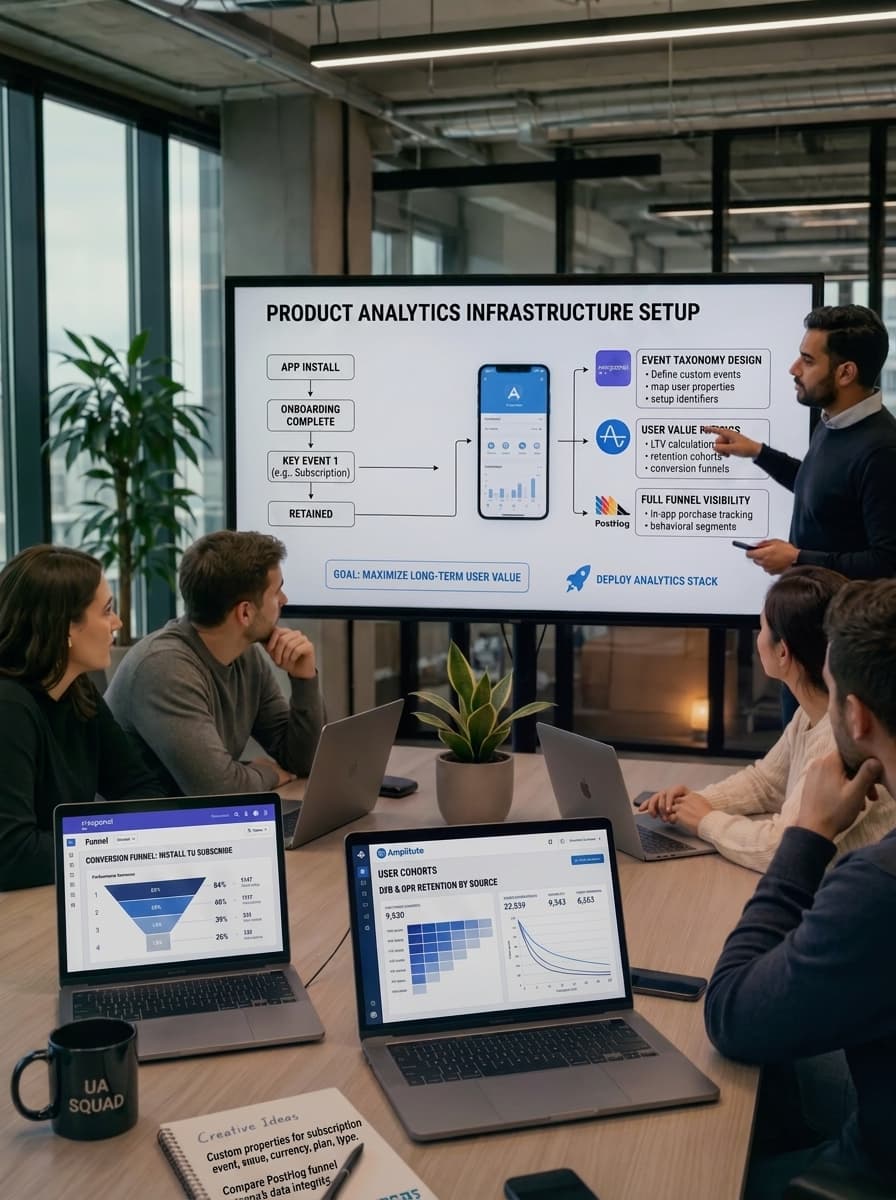
We build the product analytics infrastructure in Mixpanel, PostHog, or Amplitude, from event taxonomy to dashboards, so your data finally answers the questions your growth decisions depend on, and keeps answering them as you scale.
A missing measurement layer doesn't look like a problem. It looks like a healthy ROAS that never reaches your MRR.
Your MMP tells you where users came from, not whether they onboarded, converted, or churned on day three. So the team optimises for install volume, and the day-7 drop-off gets explained with a guess.
Three months in you're scaling the cheapest channel, not the one with users who stay.
Analytics installed, only default events
You shipped Mixpanel and fire an App Open event. There's no event for the onboarding step where users actually drop, or the moment they convert, so the funnel is invisible exactly where it matters.
No consistent event taxonomy
Every developer tracked their own way. Names collide, parameters are inconsistent, so nobody trusts a funnel report enough to act on it.
Channel quality is invisible
You know how many users each channel sent, not which stayed. A cheap channel that churns looks identical to one that delivers users who pay for a year.
Already have product events but the numbers don't reconcile across tools? That's a different problem.
An event taxonomy and analytics stack built around how users actually convert.
Five steps. Fully documented at every stage. Nothing handed off until it's validated.
Timeline
All of the this in just two weeks!
“Muffaddal is a top notch expert. He is meticulous and has a vast knowledge of Firebase and tagging strategies. He helped us tremendously in our Firebase implementation and we were successful due to his wonderful assistance. Muffaddal is one in a million; he is amazing.”

Lee Sherry
Head of Data
Geocaching
Instrumentation your team uses to make decisions every week.
A full event taxonomy document
Every funnel event defined, named, and documented with firing conditions and parameter schema. A reference your dev team uses for every future feature, so the data stays consistent instead of fragmenting again in six months.
Analytics platform fully configured
Project structure, identity resolution, user properties, and funnel definitions set up correctly. Built around how your app converts, not the default layout. Ready to query without a data engineer in the room.
Retention and funnel reports
Day-1, day-7, and day-30 retention by cohort and acquisition date, plus the onboarding and activation funnels with every drop-off and conversion rate. The reports that tell you whether growth is working. Not just whether users arrived.
Channel quality dashboard
Each acquisition channel scored by user quality, not just volume, which channels bring users who activate, retain, and pay. So you can stop funding cheap installs that churn.
Full documentation
Implementation spec, event dictionary, and platform configuration documented. Your team maintains and extends it without us when new features ship.
Before you reach out.
Our side takes one week. Dev implementation typically adds another 10 days depending on your team's availability and release cycle. The taxonomy and configuration work is never the bottleneck. Getting the event instrumentation into a build is. If you have a release coming up soon, that's usually the best time to start.
No. I work across Mixpanel, PostHog, Amplitude, Firebase for product analytics, and Segment, RudderStack for CDP. If you haven't chosen yet, I'll recommend the right one for your stage and use case. The taxonomy I design is documented independently of the platform, so if you migrate later, the underlying event model carries over.
Yes. I start with an audit of what's already firing. If there are events worth keeping, I build around them rather than rip them out. If the taxonomy needs redesigning, I tell you upfront, and your developers only implement what's actually missing, not a full rebuild for its own sake.
Yes, and the difference is usually larger than teams expect. Client-side tracking depends on a browser or app successfully firing a tag, and ad blockers, cookie restrictions, in-app browsers, and dropped sessions silently remove real events with no error. The fix is a parallel server-side layer across the full funnel, product view, add to cart, checkout, and purchase, that captures the advertising click IDs server-side so events still attribute to the right campaign. I run the server-side path alongside your existing client-side tracking first, measure the gap between them directly on the same traffic, and only promote server-side to the primary signal once the data confirms it is capturing more. Running both in parallel means the decision rests on your real numbers, not a projection.
Scope varies depending on how much instrumentation already exists, which platform you're on, and how complex your funnel is. Email us your requirements and I will share the detail proposal with scope and timelines
How HappyShyPeople turned untracked paid web traffic into a fully attributed web-to-app funnel
Meta and Google campaigns were sending real traffic to the site, but none of it mapped back to app installs, or to the ad platforms for optimization.
Firebase Traffic Source Attribution Guide
A comprehensive guide on how Firebase Analytics attributes traffic sources and handles conversion events.
See which users are actually worth acquiring. Before you scale.
Not every channel that looks cheap actually is. Reach out, and let's find out which ones are worth funding, and which are quietly burning budget on churn.