
Your measurement stack exists.Something in it is lying to you.
Meta reports 2.8x ROAS. Your revenue dashboard shows 1.4x. Nobody can explain the gap. We go through the full stack from SDK to dashboard, find exactly where it breaks, and rebuild it. This isn't a report of findings. It ends with a working stack.
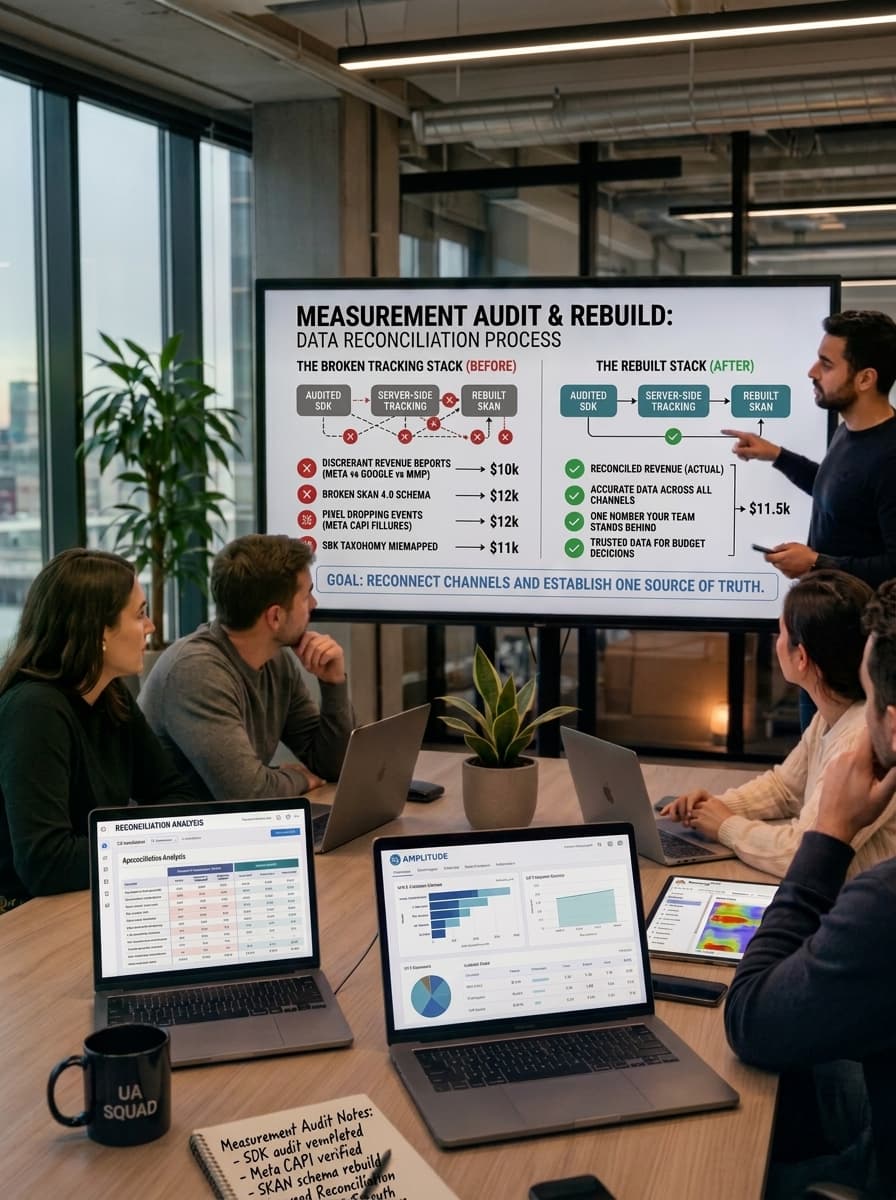
A broken stack doesn't fail loudly. It lies consistently enough to seem plausible.
You cut a channel because it looked expensive, scaled another because SKAN looked strong. 2.8x isn't alarming, so nobody questioned it. Three months later, the revenue isn't there, buried somewhere in postbacks misfiring, a SKAN schema tuned for installs, or missing server-side tracking.
The stack looked like it was working. It just never tripped an alarm.
Platform ROAS doesn't match backend revenue
Meta reports 2.8x. Your revenue records show 1.4x. One of them is wrong, and until you reconcile against actual transactions, you're allocating budget on a number you've privately stopped trusting.
Multiple 'truth' sources that don't reconcile
The MMP says one thing, SKAN says another, the BI dashboard says a third. Each was set up by someone different, and every growth review starts with an argument about which number to believe.
Product analytics gaps nobody can explain
Events fire some of the time. Funnels have drop-offs that don't match reality. The data that should diagnose the problem is suspect too.
Haven't started spending yet and want it built right from day one? That's a different problem.

Every layer audited. Every break documented. The whole stack rebuilt.
Six steps. The audit is passive. We only touch live systems once the rebuild plan is signed off. Nothing handed off until the numbers reconcile.
Timeline
For audit to fix everything, two weeks max!
“Muffaddal clearly understands attribution and tracking immensely well. His auditing and support have opened up new insights, allowing us to better understand our commercials and our customers. Thanks to his support, we now have better visibility into user behavior, and campaign impact across channels. I would highly recommend working with him”

Andrew Harkness
Chief Executive Officer
Propelahed
One reconciled number per channel. Backed by a rebuilt stack.
Full audit and gap report
Every break in your stack documented. What it is, why it's happening, and what it's costing you in measurement accuracy. The diagnosis you can act on even before the rebuild begins.
Rebuilt MMP and pixel configuration
Postbacks remapped, partner integrations fixed, fraud prevention active, cost data flowing. Across Meta, Google, and TikTok. Built around how your funnel actually converts.
Rebuilt SKAN schema and server-side tracking
A new SKAN conversion schema designed around revenue events, not installs, with Meta CAPI and server-to-server tracking live and validated. iOS purchase conversions visible again. Documented so your team understands every mapping.
One reconciled number per channel
A validated dashboard where Meta, your MMP, and your revenue source agree. The number you walk into budget meetings with, and a clear answer to where the next dollar goes.
Full rebuild documentation
Every break, every fix, and every configuration decision documented. What was changed, why, and what to check when platform updates roll out. Your team maintains it without us.
Bridebook was running $100K+/month in paid acquisition on a stack where SKAN was completely non-functional. Every layer quietly reporting numbers nobody thought to question.
The audit found five gaps, not one bug: SKAN returning no iOS conversion data at all, a “100%” ATT consent rate masking the real one, disabled view-through and re-engagement attribution, revenue never mapped back to any channel, and deep-funnel events that never reached the ad platforms.
Once the stack was rebuilt, the campaigns turned out to be performing 41% better than the reports had shown. They weren’t underperforming. The measurement was.
Before you reach out.
Attribution model differences account for some of the gap. Different windows, different view-through rules. The first thing I do is quantify what's explainable by model differences versus what's actual misconfiguration. In most audits the gap is far larger than model differences can account for, and you'll see exactly how much is which before any rebuild starts.
The audit phase is entirely passive. I don't touch a live system to diagnose it. I only change things in the rebuild phase, after you've signed off the plan, and it's sequenced to minimise disruption. SKAN schema changes take effect going forward only, so historical campaigns aren't affected.
I'll usually recommend fixing the instrumentation first, then migrating if you still want to. Switching MMPs with a broken stack just moves the problem to a new tool. The event taxonomy and tracking plan I rebuild are designed to be MMP-agnostic wherever possible, so the hard work carries over if you do migrate.
That's the normal case, not the exception. The most expensive attribution problems never throw an error. Bridebook came to me for a routine second-opinion audit on a $100K+/month program with nothing alarming on any dashboard. The audit found five separate layers quietly wrong: SKAN returning no data at all, a fake 100% ATT consent rate, view-through, re-engagement, and reinstall attribution silently disabled, revenue not mapped to any partner, and deep-funnel events never reaching the ad platforms. Every one rendered a plausible number. I check what each layer should be emitting against what it actually is, so the gaps that look coherent enough to never get questioned are exactly the ones that surface.
The common failure is several events all independently reporting the same revenue. In a consumer-app review before their first campaign, a code review found seven separate events each flagging revenue back to AppsFlyer. When several fired on one transaction, a single sale got counted multiple times, and the inflation looked exactly like real performance. The second half is SKAN revenue buckets set so wide that most purchases collapse into one range, so the ad platform can't tell a high-value buyer from a low-value one. I trace every event that reports revenue in the codebase, consolidate to one clean source of truth, and rebuild the SKAN ranges around your actual purchase distribution.
When install counts look fine but revenue won't tie out, the leak is usually silent and server-side: purchase postbacks being sent and rejected before they ever reach the MMP, with no error surfaced on any dashboard. A missing or wrong auth header returns a 401, the postback is dropped, and the numbers just look a little low. I diagnose it in the postback logs rather than the dashboard, fix the routing, and validate that events land with a 200 before calling it done. I also check for revenue that isn't being mapped back to partners at all, which produces the same symptom from a different cause.
A fixed stack. The audit produces a prioritized list of what's broken and by how much, but the engagement doesn't end there. The rebuild phase corrects each gap the audit found, in a sequence designed to minimize disruption to live campaigns, and every fix is validated before handoff. You get a working, documented measurement layer, not a deck describing what's wrong.
Scope depends on how many channels you're running, which MMP you're on, and how many layers turn out to need work, which the audit determines. Email us your requirements and I will share the detail proposal with scope and timelines
How a consumer app fixed a broken revenue signal before a single ad campaign ever used it
Seven different events all reported revenue, and the SKAN buckets were too wide to tell purchases apart. Both fixed before the first campaign launched.

The Complete SKAN 4.0 Setup Guide
How to configure your conversion schema around your actual monetisation events, so your iOS attribution data is finally worth trusting.

Find out exactly where your measurement stack is breaking, and fix it.
Your platform ROAS and your revenue don't agree? One of them is wrong. Reach out and find out which one, before you spend another dollar against it.