You're about to spend on paid acquisition.Make sure the measurement is ready before you do.
We build the full attribution stack before your first campaign goes live, so it's right from day one.
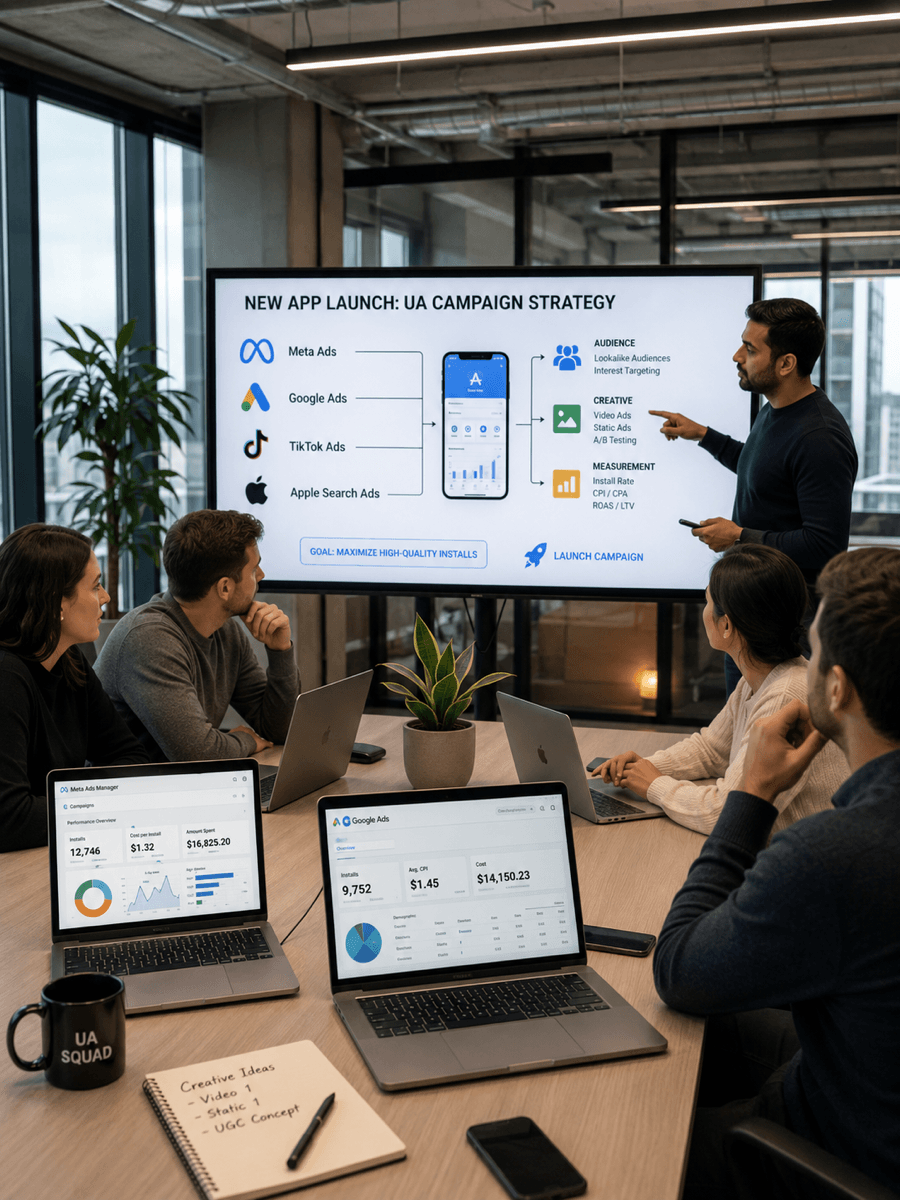
Bad measurement doesn't announce itself. It compounds, quietly, until it's expensive to fix.
Meta over-reports installs when the postback fires on the wrong event. SKAN runs the wrong conversion values, so your D7 ROAS looks better than it is. No server-side tracking means a real share of your iOS conversions are simply invisible.
Three months in, you're scaling the wrong channels. Six months in, the data you need to diagnose it no longer exists.
Meta install count doesn't match your backend
Your MMP is connected to your ad networks, but the postbacks fire on the wrong events. Installs instead of revenue, or nothing at all. You're getting numbers; they don't mean what you think they mean.
SKAN conversion values mapped to installs, not revenue
When iOS optimises your campaigns, it's optimising for volume. Not the users who actually pay. The signals going back to Meta and Google are the wrong signals.
No server-side tracking
ATT consent on a badly timed prompt averages 30-40%. Every user who doesn't consent disappears from your attribution. A blind spot you're scaling into.
Already spending but your numbers don't reconcile? That's a different problem.
Every layer of your measurement stack, built correctly.
Ten deliverables, one accountable owner. From the SDK up to the dashboard your team reads every Monday.
Timeline
All of the above in just 1 week.
“Muffaddal is uniquely valuable because he understands both sides of the equation, the advertising platform and the MMP side, which removes a tremendous amount of friction from the process. We scaled advertising spend to over $100K per day.”

Jose Avila
VP Growth Marketing
CalAI
Tangible outputs your team owns when the engagement ends.
A configured, validated attribution stack
MMP set up correctly, postbacks mapped, partner integrations live, fraud settings in place. Built around how your app actually converts. Not the default wizard configuration.
SKAN conversion value schema built around revenue
A schema designed around your specific funnel so iOS optimisation works with real signals, not proxies. Documented so your team understands every value mapping and why it was chosen.
Event tracking plan & dev implementation guide
Every funnel event defined, named, and documented. A reference your dev team keeps and uses. Not a deliverable that gets filed and forgotten.
OneLink setup for email, referral, and social
Deep links live across every channel beyond paid. Email campaigns, referral programmes, social posts. Every tap tracked back to its source, every user landed in the right place inside the app.
MMP dashboard built for your team
A custom dashboard covering every channel, every campaign, every metric your team actually needs to make decisions. Not the default view. Built around how you run your growth reviews.
Full documentation
Every configuration decision documented. What was built, why it was built that way, and what to check when platform changes roll out. Your team maintains it without us.
Africhange was about to launch paid across four channels on a stack where 5,066 tracked clicks had produced almost no usable attribution.
We rebuilt the measurement layer end to end, web and app, iOS and Android, before the first campaign went live: a structured event tracking plan, web-to-app handoff, a SKAN 4.0 schema, and all four ad channels integrated and validated.
Meta, Google, X, and TikTok launched on attribution that could actually be trusted. The stack got fixed first. Not after the budget was already spent.
Before you reach out.
Our side takes one week. Dev implementation typically adds 7-10 days depending on your team's availability and release cycle. The configuration work is never the bottleneck. Getting SDK changes into a build is. If you have a release coming up soon, that's usually the best time to start.
Very much Involved. We handle every configuration decision, write the implementation guide, and review their SDK integration directly. What we need from your developers: codebase access for code review, and availability to push the SDK changes in their next release. We don't hand over a doc and disappear, we stay in it until the implementation is clean.
The event taxonomy, tracking plan, and SKAN schema we build are designed to be MMP-agnostic wherever possible. If you migrate from AppsFlyer to Adjust, or to any other provider, the underlying instrumentation stays intact. The MMP-specific configuration needs to be rebuilt, but the hard work is already documented and carries over.
The engagement ends with a validated, documented stack. Not an ongoing retainer. That said, if you want someone to keep reading the data after the infrastructure is in place, that's what the Mobile Growth Analyst service covers. We can talk about that once the foundation is built.
Usually neither is right on its own. They're measuring different windows, and the gap is reconcilable. The most common cause is a window mismatch: Meta counts a 7-day-click, 1-day-view conversion while the MMP is on a different default, so Meta claims credit for conversions that happened weeks later and every other channel looks worse than it is. I line up the attribution windows across Meta, Google, and the MMP so all three measure the same event the same way, then use Meta CAPI with matched event identifiers to remove the double-counting. You end up with one number every platform agrees on, instead of arguing about which dashboard to believe.
Yes, web-to-app is one of the most common gaps I close. When ads point at a website and the app install happens after, click data has to survive the jump from the marketing site to the app domain, or every install looks organic. I set up AppsFlyer SmartScript on the landing page through Google Tag Manager to capture the click IDs, configure cross-domain tracking so those IDs survive the handoff, and wire the postbacks back to Meta and Google so they can optimize toward installs. For HappyShyPeople this took every paid channel from showing no attribution to fully attributed in two days.
Yes, and pre-launch is the cheapest possible time to do it. For Africhange, a fintech remittance app, I rebuilt the SDK on web and app, built the event tracking plan covering KYC, registration, and first transfer, configured SKAN 4.0, and integrated and validated all four planned channels, Meta, Google, X, and TikTok, so each was confirmed passing data correctly before the first campaign went live. The whole launch-ready stack took two weeks. Fixing measurement before spend goes out is far cheaper than discovering it was broken three months into a budget.
Sequencing. A surprising number of stacks fire the ATT prompt before the attribution SDK has finished initializing, or only initialize the SDK after a user consents, which means anyone who declines is never counted at all. At Bridebook that produced a 100% consent rate that looked great and was actually hiding every non-consenting user; the real rate was 26%. I check where the prompt fires relative to SDK init, fix the sequence so every user is measured from install regardless of their ATT choice, and only then rely on the consent numbers.
Scope varies depending on your current stack, which MMP you're on, and how much needs to be built versus configured. Email us your requirements and I will share the detail proposal with scope and timelines
How a consumer app fixed a broken revenue signal before a single ad campaign ever used it
Seven different events all reported revenue, and the SKAN buckets were too wide to tell purchases apart. Both fixed before the first campaign launched.
What is an MMP and Why App Marketers Need One
A mobile measurement partner (MMP) attributes app installs to the right media source. What an MMP does, how it works, and why app marketers need one.
Set up measurement right before the first dollar goes out.
Your first campaign's data is only as good as the stack it runs on. Reach out before you spend, so it's built right from day one.